
When a customer needs a local service, the search usually starts with a question. “Who is the best agency near me?” “Which web developer can help my business?” “Where should I go for this service?” Increasingly, those questions can be answered with AI-powered search experiences as well as traditional search results.
That raises a practical question for business owners: how do you make sure your business is easy for search systems to understand and useful enough to be mentioned when customers are looking for an answer?
That is where AI SEO for local businesses comes in. The good news is that you do not need a secret AI trick or a completely separate kind of SEO. Google’s own 2026 guidance says the same core SEO foundations still matter for AI features: useful content, technical accessibility, clear information, internal links, strong page experience, and content that genuinely helps people.
What Is AI SEO for Local Businesses?
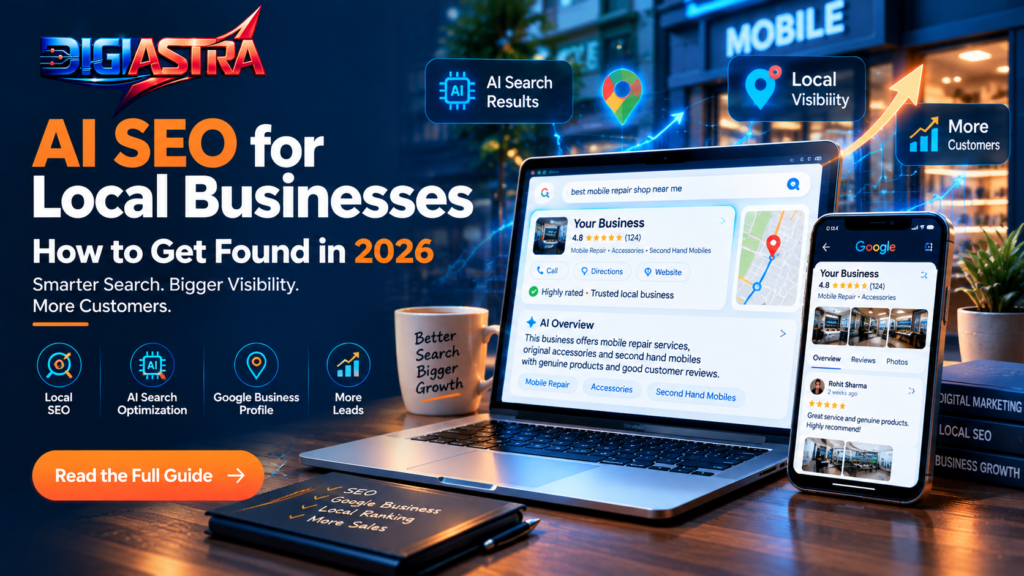
AI SEO for local businesses is the process of making your business, website and local information easier for modern search systems to understand and connect with real customer questions.
Think of it this way: a traditional search result might show ten blue links. An AI-powered search experience can combine information from several sources and present a direct answer with supporting links. Google says its generative features use information retrieved from its Search index, which means strong underlying SEO remains important.
For a local business, that means your goal is not simply to “rank for AI.” Your goal is to become a clear, credible source about what you do, where you operate, who you help, and what makes your business useful.
1. Start With a Strong Google Business Profile
For local businesses, your Google Business Profile is still one of the most important places to get the basics right. Keep the business name, category, services, phone number, hours, website and other important details accurate.
Do not treat the profile like a place to stuff keywords. Make it useful to a real customer who has just discovered your business. Add genuine photos, keep hours updated and make sure the services listed match what you actually offer.
This matters because Google’s local systems and its broader search systems use business information from multiple sources. Clear, consistent information gives search systems better context.
2. Write Pages That Answer Real Customer Questions
A lot of local websites sound the same: a short service description, a few generic claims and a contact button. That may look tidy, but it gives customers very little reason to stay on the page.
Instead, answer the questions people actually ask before they contact you.
For example, a website development company can explain what a business website should include, how much different types of websites can cost, what is needed before development starts, how long a typical project takes, and what happens after launch.
This is especially useful for AI search because Google’s 2026 guidance emphasizes valuable, non-commodity content and a unique point of view rather than content that simply repeats what is already online.
3. Make Your Local Relevance Obvious
You do not need to mention your city in every sentence. In fact, that usually makes the writing worse.
Instead, make local relevance clear where it genuinely helps: your contact page, service pages, business details, case studies, FAQs and useful local examples. A sentence like “We help local service businesses improve their online presence” is more natural than repeating the city name five times in one paragraph.
For DigiAstra, for example, an Ajmer-focused section can explain how local businesses can use Google Business Profile optimization, Local SEO and website improvements to reach nearby customers. That is useful context rather than forced keyword placement.

4. Build Topic Depth Instead of Writing Dozens of Thin Posts
One strong article can be more useful than ten short posts that all say the same thing.
Build a small content cluster around topics your customers care about: Google Maps visibility, Business Profile optimization, local SEO, website development, reviews and AI search. Then connect the articles with relevant internal links.
This gives readers a clearer path through your site and helps search engines discover related pages. Google’s AI-search guidance also recommends making important content easy to find through internal links and keeping pages crawlable.
5. Show Real Experience, Not Generic Advice
This is one of the easiest ways to make a local business website feel human.
Use real examples, screenshots where appropriate, lessons from actual projects, common mistakes you see, and practical explanations from people who do the work. Instead of saying “we provide the best SEO services,” explain what you actually check, what decisions you make, and what a client can expect.
Google’s current guidance specifically encourages unique, useful, experience-led content and warns against simply recycling information that could be produced by anyone.
6. Keep Your Website Easy for Search Engines to Access
Even excellent content cannot help much if search engines cannot access or index the page properly.
Check the basics: the page should be indexable, important content should be available in text, internal links should be crawlable, the mobile experience should be good, and your site should not accidentally block important resources.
Google says pages shown as supporting links in AI Overviews or AI Mode still need to meet the normal technical requirements for Google Search. There is no extra “AI-only” technical requirement.
7. Use Structured Data Carefully
Structured data can help search engines understand page content, but it is not a magic switch for AI visibility.
Use the structured data types that genuinely fit your page and make sure the markup matches the information visitors can see. For a local business, that can include appropriate LocalBusiness information where applicable, along with other relevant page-level structured data.
Google says there is no special schema markup required specifically for AI Overviews or AI Mode. Structured data remains part of normal SEO rather than a separate AI ranking shortcut.
8. Create Helpful FAQs Without Turning Them Into Keyword Lists
FAQs are useful when they answer genuine customer concerns. They are less useful when every question is just a slightly different version of the same keyword.
Write questions the way a customer would actually ask them, then give a direct, useful answer. Keep the answers specific to your business and avoid making promises you cannot support.
You do not need to create hundreds of question pages just because AI systems can answer questions. Google specifically cautions against producing large amounts of content mainly to capture query variations or manipulate AI results.
9. Keep Business Information Consistent Across the Web
Check your website, Google Business Profile and important business listings for the same basic facts: business name, address, phone number, website and core services.
Small differences happen, but avoid having outdated phone numbers on one page and a different address on another. Consistent information makes the business easier to understand and reduces unnecessary confusion for customers and search systems.
10. Use Original Images and Useful Visuals
Good local SEO is not only about text. A real photo of your team, storefront, workspace, project or finished work can make a business page more credible and more useful than a generic stock image.
Google’s generative AI guidance also notes that high-quality images and video can create additional opportunities for visibility when they genuinely support the page.
11. Track AI Search Visibility Alongside Traditional SEO
Do not stop tracking normal Google Search performance just because AI search is getting attention. Your traditional rankings, impressions, clicks and conversions still matter.
At the same time, Google introduced dedicated Search Console reporting for visibility from generative AI features, including AI Overviews and AI Mode, and announced that these insights had rolled out globally by August 31, 2026.
For your monthly review, track the main keyword, your Ajmer-focused local keyword, impressions, clicks, top pages, enquiries and any visible AI-search appearances you can document.
What Should Local Businesses Do First?
Do not try to change everything in one week. Start with the pages that can directly support business growth.
First, clean up your Google Business Profile. Then improve your main service pages. Add useful FAQs and local information. Connect related blog posts with internal links. Add real images. Finally, use Search Console to see which queries already bring impressions and improve those pages further.
That approach is much more practical than chasing every new AI-search acronym. Google’s own advice is clear: foundational SEO and genuinely useful content remain the foundation for visibility in generative search.
Why DigiAstra Can Help With AI SEO for Local Businesses
DigiAstra is an Ajmer-based digital marketing agency working on Google Business Profile optimization, Local SEO, website development and online visibility. For businesses that want to improve both traditional local search and their presence in newer AI-powered search experiences, a combined approach can make more sense than treating each channel separately.
If you are looking for **AI SEO services Ajmer**, DigiAstra can help you build a practical strategy around your website, local search presence, useful content and measurable SEO improvements.
Learn more about DigiAstra: https://digiastraweb.com/

Final Thoughts
AI search is changing how people discover information, but the fundamentals are surprisingly familiar. A business still needs clear information, useful content, a technically accessible website, genuine local relevance and a reason for customers to trust what it says.
That is the real meaning of AI SEO for local businesses: not writing for a robot, but making your business easier for both people and search systems to understand.
Keep the focus on helping customers first, measure what actually brings visibility and enquiries, and improve the pages that matter most. That is a strategy that can continue to work even as search interfaces keep changing.